
If you own a modern diesel car, especially the ones with an SCR system, diesel exhaust fluid is not an aspect to be ignored. In fact, if you’re sourcing DEF from or via Diesel Exhaust Fluid Dubai, you need to understand when and how often to refill to keep your car running smoothly—and legally: timely top‑ups are also key to the safety and compliance of emissions standards.

What is Diesel Exhaust Fluid and Why Does Your Vehicle Need It
Diesel exhaust fluid is the common name for a diesel exhaust fluid, a mixture of urea and deionized water (about 32.5% urea and 67.5% water). When it is injected into the exhaust stream of diesel engines equipped with SCR systems, it assists in the conversion of harmful nitrogen oxides (NOx) to harmless nitrogen and water vapour, significantly reducing emissions.
Without enough DEF, your car may not fit within the emission norms. Worse, when this tank is completely empty, many vehicles will not start up again until you refill it-a fail-safe measure if you will.
That is why it is essential not only to use DEF but also to refill it on time and properly, regardless of whether you find it locally or import it
How often should you refill Diesel Exhaust Fluid?
As for how often you refill, there is no one-size-fits-all answer; it depends on a lot of variables, including the type of vehicle, how much you drive, driving conditions, and load. However, here’s a rough guide based on typical usage:
- For diesel passenger cars, most manufacturers recommend refilling every 6,000–10,000 km (approximately 3,700–6,200 miles).
- This corresponds to approximately 1 litre of DEF per 800 to 1,000 kilometres of driving, on average.
- For commercial vehicles, vans, trucks, or heavy‑duty diesels, the consumption is higher, with some guides suggesting refills every 2,000–5,000 km or approximately 1 litre per 300–500 km depending on the load and use.
According to several manufacturers, the first warning light indicating low levels of DEF may appear after a few thousand miles. For instance, one model fires up the warning between 3,000 and 4,000 miles, another between 6,000 and 7,000 miles.
Because usage can be so variable, the best practice is to refill whenever your dashboard warning light or range‑to‑empty indicator alerts you — or proactively check every few thousand kilometres if you commonly drive long distances or under heavy load.
How to Refill: Best Practices & Mistakes to Avoid
DEF refilling is usually straightforward:
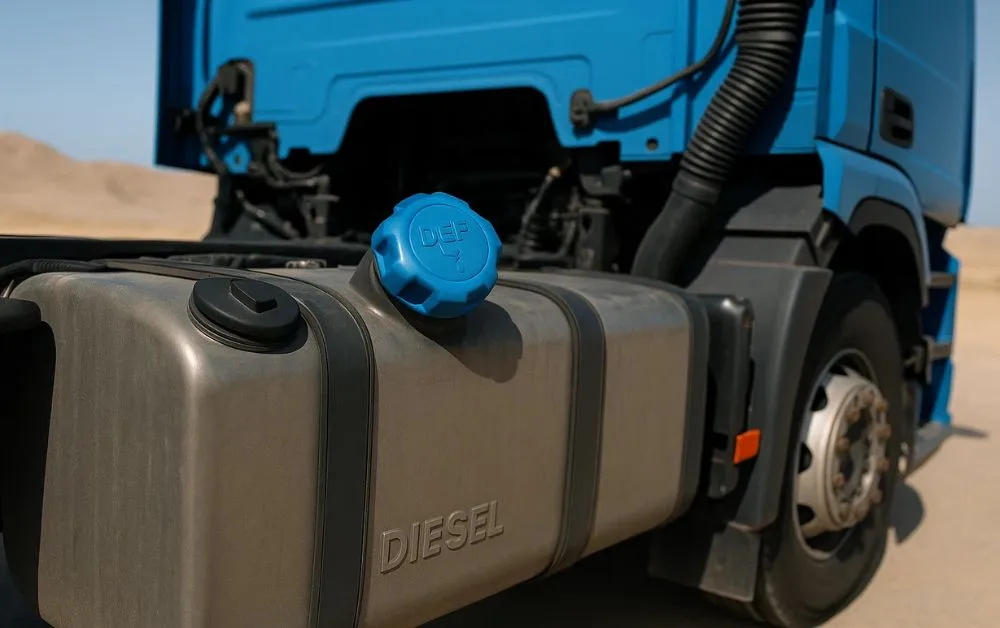
- Find the DEF filler cap. This is usually located near the diesel fuel filler cap in most vehicles, or it may be under the bonnet/boot.
- Only use certified DEF to the correct standard, and check for compliance. Water or other fluids can irreparably damage your SCR system.
- Use a clean funnel or anti-spill nozzle: To avoid contamination or spillage when pouring.
- Do not overfill: Fill only up to the maximum indicated level, and tighten the cap securely.
- Some vehicles may require a dashboard reset or a short wait before the car recognizes the refill after topping up. Always refer to your owner’s manual.
Other important pointers:
- Use DEF from reputable suppliers: low‑quality or contaminated DEF can clog the SCR catalyst or injectors and causes expensive maintenance costs.
- Store DEF properly when not in use: in a cool, dry place away from direct sunlight and extreme temperature fluctuations.
When to Plan Your Refills: Some Smart Strategies
To avoid sudden breakdowns or “limp mode” situations, it makes sense to anticipate your DEF refills rather than waiting for a warning. Here are some strategies:
- Check the levels of DEF at every regular vehicle service or oil change: Since those often happen every 5,000–10,000 km, it’s a good checkpoint.
- Refill before a long journey: Any long drives or journeys with heavy loads typically increase consumption of DEF, so top up in advance to avoid mid‑journey problems. Suggest to have at least 100L volume ( 5 jerry cans)as ready stock for long hauled vehicles.
- Always keep a small spare container in your car or garage: In this way, you have an emergency top‑up option available if you run low far from a refill station.
DEF consumption – Why it varies: Factors that affect this metric
Not every diesel car uses up DEF at the same rate. Some key influencing factors:
- Vehicle size and type: smaller passenger cars consume less; large SUVs, vans, trucks, or heavy‑duty diesels use more.
- Driving style & load: Urban driving with stop‑start traffic, heavy loads, towing, or aggressive acceleration all increase NOx emissions — and so increase usage.
- Distance and frequency of trips: long highway runs at steady speeds may be more fuel efficient and consume proportionally less DEF; short trips might consume more per km due to cold starts.
- Ambient Temperature and Environment: Very high or low temperatures may at times impact the system’s demand and the way the fluid is injected/metabolized. Although guidelines may vary, proper storage and timely refill become more critical in harsh climate conditions.
Due to this variability, the mean estimates should be considered as general approximations: 6,000–10,000 km for cars and 2,000–5,000 km for heavy vehicles. The dashboard indicator remains the most reliable signal.
Sourcing DEF — What to know if You’re Buying
Whether obtaining DEF internationally such as through Diesel Exhaust Fluid Dubai, for fleet or individual vehicle owners it is important that the product meets standards and is adequately managed during transport and while being stored. The use of substandard or contaminated fluid, or improperly stored fluid will jeopardize the SCR system and lead to expensive repairs as well as problems with your engine.
Among the Middle Eastern countries, Dubai & UAE have various reputed manufacturers and suppliers of quality diesel exhaust fluid products. If you are sourcing from abroad or within GCC markets, make sure your supplier maintains proper handling and storage conditions, and that the product is genuine.
Using trusted suppliers reduces risk — and ensures your vehicles remain compliant with emission regulations.
Conclusion
It is essential to keep in mind, however, that diesel exhaust fluid is more than just a fluid. It is a tool of compliance, an instrument of environmental protection, and frequently an obligation. Although it is acquired domestically or internationally, like Diesel Exhaust Fluid Dubai, keeping a close eye on your DEF level, frequently refilling and ensuring regular, timely refilling are the best rules to follow. The refill frequency varies depending on the type of automobile: for passenger diesels, it is frequently every 6,000-10,000 km, with an average of approximately 1 litre per 800-1,000 km; buses, trucks, or commercial vehicles may need to top up every 2,000-5,000 km. This translates to filling at every other service or before lengthy travel and using exclusively approved DEF while appropriately storing it. If you get your DEF from a vendor like Blue Middle East in Dubai and UAE, rest assured that this is a product of high quality and conformity, which is required to save your engine’s SCR and avoid service interruptions. The next time you plan for a refill, treat diesel exhaust fluid like your fuel — not optional, but necessary.